Talking to Your Healthcare Providers About Accessibility
Author: Sheri Denkensohn-Trott
National Women’s Health Week provides an ideal opportunity to raise awareness for providers and individuals with disabilities about issues that will increase the quality of care. I am a quadriplegic of 36 years, and a 10-year  breast cancer survivor. As a result, I have had many hospitalizations and continuously engage in routine healthcare. Through my experience, there are three areas that I am passionate about.
First, it is vital to talk to your provider about the need for accessible exam tables (those that go up and down) so individuals with disabilities and others with difficulty getting on a high table, are examined appropriately. I rule out providers that do not have an accessible exam table This is especially important with respect to OB/GYN care. A pap smear done in a wheelchair is ineffective. An individual with a disability must be examined on an accessible table for the result to be accurate.
Second, as a breast cancer survivor, is important for the individual with a disability to inform the front desk before the appointment that they have a disability, and in the case of a wheelchair user, that the appointment should be scheduled for one hour with an extra person to assist. Even if the mammography machine moves up and down, without assistance to maneuver and bend, the mammogram will be difficult and potentially 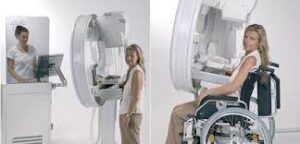 inaccurate. There is a new mammography machine available by the company GIOTTO that comes to the person (like in a dentist’s office) instead of the individual trying to awkwardly maneuver.
These machines are not widely available and that should not be the case. This technology is needed because the aging population will likely require easier access for mammograms. Additionally, all mobile mammogram vehicles must be equipped with a lift so individuals with disabilities are not excluded. Prevention is better than cure.
Third, telemedicine is a great form of communication with one’s provider during this pandemic as well as under normal circumstances. It alleviates the trip back and forth to the provider and facilitates a conversation about routine issues, symptoms, concerns, and dialogue about pertinent questions. For there to be an even playing field, this technology needs to operate on a platform that incorporates captioning or subtitles. Individuals with hearing difficulties should not be excluded from utilizing telemedicine.
These are just three of many examples where an open dialogue with the provider about specific accessibility needs will lead to a positive outcome. Individuals with multiple chronic conditions will avoid going to the doctor or any other healthcare provider if it is difficult and/or inconvenient. These barriers can be overcome. Provider education is a great way to address the needs of individuals with disabilities. But it is a two- way street. Individuals with disabilities need a level of comfort addressing their needs in an open and compassionate environment.
As science continues to advance, changes in healthcare will occur at rapid speed. Including the perspectives of individuals with disabilities in the development and user phase of new equipment and technology is vital. Additionally, provider education at all levels (even medical and nursing school) should include knowledge of the needs of individuals with disabilities. This will result in better and more efficient care and ultimately result in a win-win for everyone.
 news every evening and usually watching the local news again at 11 for possible breaking news, sports scores, or weather updates. During this pandemic though, watching that much news in one day can be quite dispiriting. We rarely picked up the telephone to talk to a loved one because of my lack of hearing but I’m trying to use a new translation tool by Google to make it easier on the phone and when people are talking on the computer.
 over. We do make watching Jeopardy a continued activity, and many times it is the point when we just breathe
 the Rookie on Sunday evening. OK, some plotlines may be kind of corny, but we need some of that these days.
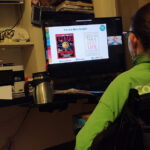 taking advantage of the myriad of lifelong learning practices through webinars/podcasts. This is something that we have always wanted to do, but never had time. And personally, getting together on a weekly basis with certain members of my family for a virtual Dungeons & Dragons game is a great stress reliever!
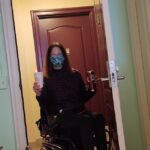 safe, healthy, and strong during this pandemic. We are lucky to have family, friends, and even strangers offering to help us by going to get what we need from the grocery store, medical supply offices, and other areas that have goods that we need.
 What infuriates me are the people out and about without masks and/or in large groups. This is unacceptable and non-compliant. I’m sorry if you feel inconvenienced, I am sympathetic to the fact that you are lonely and want to be with your friends, but I’m surely not in agreement with your failure to wear a mask.