
Rolling Against Breast Cancer
Sheri Denkensohn-Trott: Sheri participated in her first Making Strides “roll” in October 2010. Sheri has been a quadriplegic for over 34 years, paralyzed from the neck down as a result of a diving accident, and therefore uses a motorized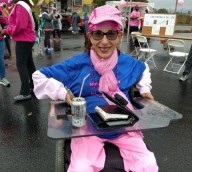 wheelchair. She is also a seven-year breast cancer survivor- diagnosed in July 2010, had surgery in August and was introduced to MSABC through her sister-in-law who heard about it from a breast cancer navigator when she went for her yearly mammogram.
“Being a part of MSABC has been a game changer for me,” says Sheri. “I have met wonderful people, interacted with strong survivors, and made lifetime friends. It connected me to a network of those who have lost friends and family to breast cancer and those that continue to fight each day.”
Sheri’s first efforts of fundraising started mainly through email and Facebook. She became a Pacesetter her first year, and has continued to be a Pacesetter every year since- raising over $50,000 in her seven years of being involved! “It takes diligence and a lot of time to sustain the fundraising effort, but it is well worth it,” says Sheri.
What’s her secret? Passion for the cause, as well as her own story as a quadriplegic and breast cancer survivor. Her passion and story has attracted others with breast cancer to join her team, Undaunted Determination, and many of her team members have also become Pacesetters.
Sheri continues “None of this can happen without a wheelchair accessible venue, and MSABC in DC has ensured that accessibility is not a problem. Many of my friends that use wheelchairs, including my husband, have joined me for the roll. This is a universal fight and impacts people from every demographic, including individuals with disabilities. As a woman with a disability, American Cancer Society Ambassador, and Pacesetter, I say to everyone, “you can do it!” Let’s keep rolling on!”
 the top 10 etiquette issues that I have faced over and over again.
 Number 4. Elevators are for individuals who need them; people with disabilities like me, the aged, those with strollers, or people lugging many suitcases. For their own convenience, people ignore the signs in the Metro. I’m not ashamed to push right to the front and tell able-bodied individuals to get out of the way, and this has happened almost every weekend when Tony and I go down to Capital One Arena for basketball games. It boggles my mind that if you have the option to use an escalator that you would actually use an elevator in front of someone who has no other option. And if you do choose to use the elevator, at least go outside of the elevator and hold it open with your hand so that the wheelchair user can get out without the door closing. Don’t stand inside to hold it because you will be in my way and possibly get your toes run over.
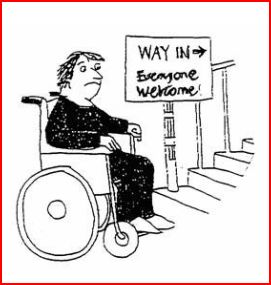 requires NO steps. More than once I have called ahead to ask if a venue is wheelchair accessible, have been told “sure,” and have arrived with friends only to find that and I can’t get in. This happened to me at a venue where a band was playing downstairs and there was no elevator and I was not informed when I called to inquire. So, of course, I couldn’t see the band and I was humiliated. I wanted to crawl into a corner and hide.
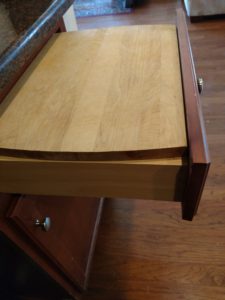 I can’t necessarily advise on what type of setup will work for you; I can only tell you what works for me. One thing that works for me is to make a surface that I can wheel under for cutting, mixing and doing other prepping of ingredients. I accomplish this by pulling open a drawer that I can roll under and laying a piece of plywood or a big cutting board across it to make it a prep surface. This works well for people who use wheelchairs and those who don’t but just need some extra prep surface. In my case, my wheelchair has a tray that I am able to put on and take off, so I have options on how I want to do my prep work. I tend to use the tray more often.
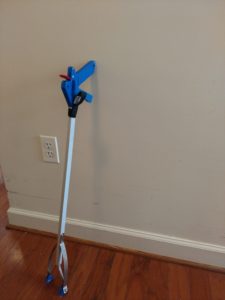 impossible to reach?