
Religious Organizations Must Be Inclusive
 When it comes to disability, religious organizations still do not fully understand inclusion. As a result, they are missing an opportunity to learn, adapt, and lead.
I was raised in a conservative Jewish household in rural upstate New York, attended Hebrew school, and was Bat Mitzvahed at a synagogue almost 30 miles away from my home. There were only three Jewish students in my entire school, so religious diversity was limited, and disability inclusion wasn’t even on the radar.
In 1983, when I was 16, I became a quadriplegic and returned to high school after a long period of rehabilitation. Between being Jewish and having a disability, I felt different, like I didn’t belong.
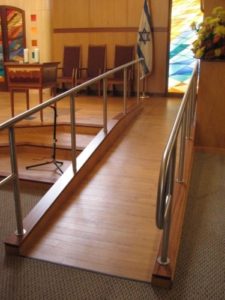
There was no refuge in the synagogue my family attended, since it was not fully accessible. The bima (altar) had steps and the bathroom was not wheelchair accessible. In fact, after my injury, I never went back to that synagogue. My own personal internal struggle of trying to deal with my injury had me questioning whether there even was a God, so I had no interest in going back to an inaccessible synagogue.
After high school, I attended college at the University at Albany. There I experienced diversity and, without realizing it, being part of an inclusive community. There was a large population of Jewish students and our voices were heard. I had never been around so many other Jewish people, and I felt like I finally had a religious identity, something I had never experienced. Because of the presence of other Jewish students and our school’s inclusion of people with disabilities, I felt like I belonged.
Because of the Rehab Act, which preceded the ADA, religious services on campus were fully accessible. They weren’t just physically accessible — there were also sign language interpreters and Braille prayer books.
As vice president of Disabled Students Services, I was consulted in the planning of Jewish events and celebrations on campus to ensure they were as accessible as possible. I did not want anyone who was disabled to feel excluded from participation in Jewish events on campus — or any religious events on campus.
It is hard enough dealing with a disability and the feeling of being “different,” so ensuring that religious events on campus were accessible was extremely important.
So what lesson can you learn from my experience? If you are a religious leader, ensure that you have at least one person with a disability on all planning committees for major events and especially renovations. While one disabled individual cannot represent all, that person should be able to consult with others in their network to help your congregation include people with all types of disabilities.
If you don’t have anyone with a disability in your congregation to help, then your congregation should make it a priority to attract more diverse members. Congregations, like all organizations, benefit from having diverse perspectives. Many of us who experience disability are very resilient, and our perspective will likely benefit all members.
I am confident that if an organization shows a serious intent to be inclusive, volunteers with disabilities and/or those familiar with different disabilities will come forward.
As part of a conscious effort to ensure your worship services are accessible to all people with disabilities, ask yourself these questions: Is your facility and key areas, such as altars, physically accessible? Do you have prayer and song books that people with visual impairments can use? How about a service dog policy, or ASL interpreters? Is your seating area designed so that scooter or wheelchair users can see what is going on without feeling like they are sticking out in the aisle?
It may help to imagine you need access and that your grandchild, spouse, sibling, child or dear friend would like to honor you by calling you up to the front of your congregation. Is this possible in your house of worship? It would be awful if you could not fully participate in a celebratory event or a funeral in your own house of worship because of lack of access.
Full inclusion and access is the right thing to do.
https://happyonwheels.com/religious-organizations-must-be-inclusive/
 house so I could have a bedroom and bathroom on the main floor (we installed a lift from the garage); and my town was very rural, so getting around was quite difficult. I had a power-wheelchair and van on order, but until both arrived I was using a manual chair and had to be pushed and my father was lifting me in and out of his car. Bottom line, my ability to get around outside of our home was extremely limited.
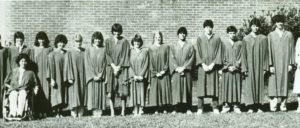 ar and lifted me into my wheelchair. As he pushed me toward the high school doorway, I was sobbing saying over and over “I don’t want to go, I don’t want to go.” But he kept pushing me. As we approached the school, I tried to stop crying and smile and say hello to everyone that was crowding around me. I don’t remember anything about the ceremony and, in fact, my only memory about the school was looking at my locker and remembering what my life used to be like. My mind was racing with a million thoughts. Instead of sitting in a seat in the auditorium, I was on the stage sitting in a wheelchair. All I could focus on was how different everything was. The experience was devastating to me.
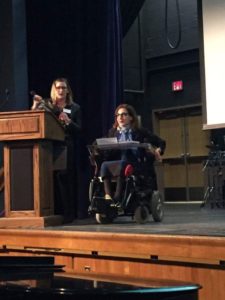 but I am unleashed with independence by my environment. I live in an area where there is accessible public transportation, and I can easily roll in my wheelchair to the grocery store, pharmacy, cleaners, movies, out to dinner and partake in a variety of other activities. I am not focused on my restrictions. Although they do exist, I am able to see the value in developing independence and capitalizing upon it.
 I have been thinking and reading a lot about the concept of grit, as my friend and coach Caroline Adams Miller is writing a book about it and Angela Duckworth, well known for her research in this area, has been writing and speaking on the topic. Grit is all about being resilient. Failing and getting back up. Not expecting to be praised for every little thing and realizing that life is not perfect. The subject is timely given our current societal norms where children and even adults expect to be praised and not criticized; where thinking outside of the box and potentially failing is not valued; and where taking a risk is viewed as the wrong path to take because the result may not be immediate success.
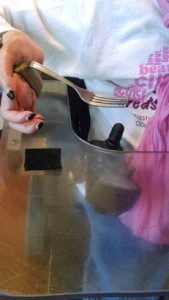 and got all of the food into a position where I could reach it. He then gave me my call bell and started to walk out of the room. When I asked where he was going he said, “You can eat by yourself, call me when you are done.”