
Author: Sheri Denkensohn-Trott
Lately I have been running across a variety of blockades. Curb cuts, parking spots, sidewalks, all blocked by different forms of  transportation and objects. I’d like to think it is not intentional, but unfortunately it represents a lack of knowledge about individuals with disabilities, laziness, and a general lack of interest in the surroundings.
The most egregious is parking spots. In many cases, it is parking in a disabled parking spot by someone who does not have a hanging tag indicating disability or a disabled license plate. The excuse, “It will only take a minute so I will just use this space because it is closer,” doesn’t make this conduct okay in the least bit. Because right at that moment, I may drive up in my van to park. Second is parking on the hashmarks next to a handicapped parking spot. This happened to me recently at a 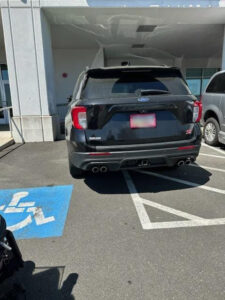 medical appointment. The vehicle did have a hanging handicapped parking tag, but it was parked on the hashmarks instead of in the parking spot. Therefore, when I pulled in, I was unable to get out of the van because my ramp opens on the side.
Next are stores where for some reason individuals won’t or don’t take the time to bring their shopping cart back to the entrance. Right there, in the middle of the spot where I need to pull in, is a grocery cart. My attendant must stop the van, move the cart, and then we can park. Yes, I do utter some choice words.
Most recently I have encountered curb cuts blocked by scooters. I live in a community that is very accessible and the curb cuts are numerous. But, with the advent of scooters, it seems to be a 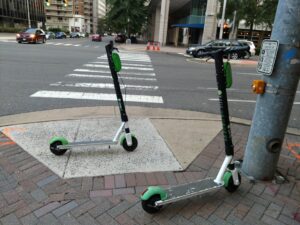 habitual practice for individuals to get off the scooter, leave it in the middle of the curb cut and go off to their destination. Or individuals park the scooter near the curb cut and a brisk wind blows the scooter over and it completely blocks the curb cut. This makes it impossible for me to navigate and cross the street.
These actions interfere with my daily living. I cannot navigate independently and swiftly when others don’t follow the rules or are not cognizant of how their actions may impact individuals like me. Please, help those of us who are fighting for accessibility every day. If you see someone park a scooter in the middle of the curb cut, say something. If you see a vehicle illegally parked  in a handicapped parking spot, call the nonemergency police number. They are authorized to ticket.
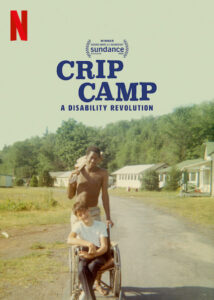 be free from the constraints of others and the ability to be treated as human beings with thoughts and desires. I watched with tears running down my face, feeling almost guilty for my “luxuries” in life as a woman with a disability. I am a quadriplegic injured in 1983. Things were far from perfect, but my parents would never contemplate that I should be kept home from school. I missed my entire junior year of high school, but teachers from my school in the small town where I grew up came and tutored me for free in the summer and I was able to go back senior year and graduate with my class.
 that entities like state colleges, have programs and activities accessible to individuals with disabilities. The statute was not clear as to what “accessible” meant.
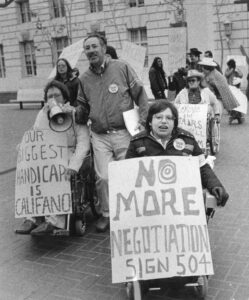 days doing sit ins in the West Coast office of the Department of Health, Education, and Welfare (the precursor to the US Department of Health and Human Services). This same group of activists stopped traffic in the middle of NYC, and eventually came to Washington DC and climbed up the steps of the Capitol on their hands and knees. Those individuals fought with their lives for the civil rights that we have today.
 Let’s celebrate what we have achieved over 30 years. At the same time, we cannot forget those who gave their lives to get us to where we are today. We need to continue the fight. We are a community. Let’s rise up, use our voices, and make sure that the ADA is followed going forward and that accessibility for all is embedded in the minds and hearts of our leaders.
 wheelchair part-time for about 5 years. So, the true importance of accessibility was not really something I was, personally, worried about for myself. Of course, things are quite different now and I am extremely aware of accessibility issues (and, of course, issues of inaccessibility). I have been a full-time wheelchair user for about 17 years and unless there is a miracle, I will be for the rest of my life. To me the ADA means access of all kinds; physical, emotional, psychological, et al.
 be added to the previous sentence: who know how to apply it.
 build counters that are inaccessible? Why do hotels say they have roll in showers when they don’t? Why do stores say that they are accessible and upon arrival there is one step? Understanding what is required from a range of individuals is necessary to fully realize the benefits of the ADA. If I had my way, every architect, doctor, developer, and store owner, among others, would receive a crash course on what is required under the ADA. It is only then that we will reach systemic accessibility because it will be applied correctly from the start.