Author: Tony Trott
I was watching an episode of American Experience on PBS last week about the passage of the Americans with Disabilities Act (ADA) in 1990, and the quote from Anita Cameron about the ADA being the floor and  not the ceiling really made me think. Not only about the beginning part of it (“I’m grateful for the A.D.A. I pushed for it, I fought for it, I went to jail for it.”), but also for the second part (“But the A.D.A. is the floor. It’s not the ceiling.”) Of course, I am forever grateful and enormously thankful for those who gave up so much of what they had for the sake of others with disabilities, but it was the second part that really made me think.
“But the A.D.A. is the floor. It’s not the ceiling.” What a great reminder! The ADA is a law of empowerment; it’s not one of entitlement. As people with disabilities, we must learn about the law and know how it works and how we can utilize it to make our lives, and the lives of future generations who have disabilities, better and, at least to some degree, easier. What’s even more important about the second section is that there is still noncompliance with the ADA. So many entities are not even meeting the floor. The ADA is good for everyone; universal design has been shown to benefit women with strollers going up a ramp as well as delivery people; adequate spaces in aisles of stores gives room for multiple carts to pass at the same time. It makes sense. And, while you are at it, do you need to meet the basic requirement? Just because an automatic 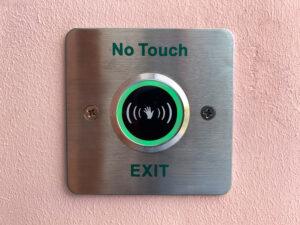 door is not required on a bathroom, why not install it? During the height of COVID many of the automatic door openers did not require you to put your hand on it, you wave and the door opens. It is more is more sanitary and not more expensive. So why not have that all the time?
I could go on with examples but hopefully you get the point. While we advocate to meet the floor, we should explain why reaching for the ceiling is not cumbersome and burdensome. It makes common sense. Let’s listen to Anita.
 also offer a warning: what is given can be easily taken away. A law requires action to be enforceable otherwise it gets dusty on a shelf. And the fight for progress never stops. We must remain vigilant. This means both those with and without disabilities.
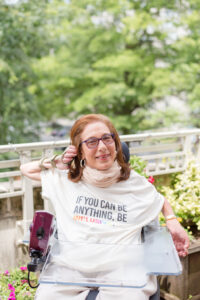 when I had my accident almost 41 years ago. And I would admonish anyone with a disability who doesn’t try their best to advocate for positive change. We have a responsibility on our side as well.
 like restaurants, movie theaters, and the like. I’m grateful that laws such as the ADA establish and protect my rights. But, on the flipside, while the ADA has become part of our lexicon, adherence is far from established. Don’t get me wrong, there has been great progress, but in my opinion, we should be much further along than we are.
 counters, door width, automatic door openers that are placed out of reach, unnecessary steps, and parking spaces that are improperly marked or do not have the requisite layout for a van with a ramp to open. Add to that, hotels with “accessible” rooms that are not accessible, and other amenities that do not meet ADA standards.
 the concept of accessibility and the needs of those who have disabilities are receiving more attention. This is especially true in the arts, where individuals with disabilities are being cast for roles of someone who has a disability instead of an able-bodied person being cast in that role. These gains cannot be taken for granted. There is progress.