Author: Sheri Denkensohn-Trott
It is the 34th Anniversary of the Americans with Disabilities Act (ADA) and there is ample reason to celebrate. Historic changes have occurred over the last few years such as updating archaic regulations for medical diagnostic equipment for individuals with disabilities, designating those with disabilities as an underrepresented group so that more funding can be directed for research, infrastructure money to improve access to transportation, and more money to support home-based care services. While this list is not comprehensive, regardless of political party, it shows evidence of significant progress. The trailblazers who fought for the precursor to the ADA, the Rehabilitation Act of 1973, would be proud. But they would likely,  also offer a warning: what is given can be easily taken away. A law requires action to be enforceable otherwise it gets dusty on a shelf. And the fight for progress never stops. We must remain vigilant. This means both those with and without disabilities.
When I was injured in 1983 in a diving accident at 16 and became a quadriplegic, I couldn’t imagine the changes that would occur in society as a result of the ADA. When I was in the rehabilitation center after my accident, we were looked at like aliens because people with disabilities were not integrated into society. The message was clear that it wasn’t built for us. Most places, even the local shopping mall in White Plains, New York was not accessible. The thought of being able to go to movie theater and sit and watch next to my friends seemed unfathomable. But the ADA resulted in a tectonic shift.
Over 34 years there have been so many positive changes in our living environments and our ability to enjoy sports, entertainment, and travel. There is increased access to employment and higher education that has grown exponentially, especially after COVID. Remote work, telemedicine, and other obstacles removed and needed accommodations became the norm. But many fissures and views of those with disabilities as “less than” were exposed. Those of us with disabilities knew that some in our country did not view us as full participants in society, but it became fully apparent to many more.
Thirty-four years later I find myself still fighting the basics; many days I feel like I am dealing with segregation. For instance, there are still steps in new construction. Certificates of occupancy are provided when a newly constructed building has many ADA compliance violations. These include counters that are not accessible in stores, hotels and medical facilities where it is impossible to use an elevator call button because a garbage can or glass table has been placed underneath, parking spots with no hashtags to allow a lift to open, employers thinking it is too difficult to work with someone with a disability so they don’t hire the person, and transportation that has many barriers for all disabilities. I could go on.
Arguing with supervisors, managers, filing lawsuits, and doing everything I can to make the environment ADA compliant is not convenient. If our lived environments were more accessible and universal design became the norm, it would benefit everyone. It’s always a fight! I’ve always said it takes a village, but the village includes those that make these barriers when they are not needed. So, what needs to be done?
The answer is no different than it was 34 years ago. Include individuals with disabilities in the discussion. Ask. Research. It’s not that hard. We are moving exponentially into a new era of AI and other advanced technology. This is an opportunity to get individuals with disabilities to the table so that we move towards a world that is more inclusive and not less. Doing things at the outset is much more efficient and less expensive than correcting them later. I am ready to do my part. I view it as my moral obligation to leave this world more accessible than 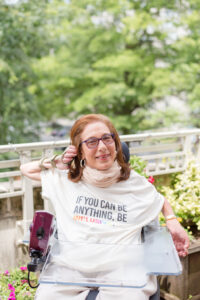 when I had my accident almost 41 years ago. And I would admonish anyone with a disability who doesn’t try their best to advocate for positive change. We have a responsibility on our side as well.
Please, let’s all be involved in making accessibility and inclusion the rule and not the exception. It’s a win-win. Be willing to learn, understand, and be open to changing your viewpoint if you are of the mindset that accommodating those with disabilities and compliance with the ADA will hurt your business, is too complex, and overly expensive, there is ample evidence that will show otherwise. And if you don’t do it, someone like me might find a lawyer (even though I already am!) And remember, anyone can join the disability club at any moment. Don’t you want the world to be inclusive for you and those you love? #AmericansWithDisabilitiesAct #inclusion #disability

 read the themes and some of them were very interesting to me. I could relate to them based on my disability and my own lived experience. I decided to try. The first theme was “Etiquette.” A story is timed, done without a script, so you must practice. I wrote what I thought was good and went with one friend. I was awful! But it was a good awful. I listened to the other storytellers, there are six at this venue. I learned what works and what didn’t. I talked too fast. I tried to fit too much text into a short timeframe. I didn’t leave the audience time to laugh and react. And speaking from a sheet of paper like a speech is not storytelling. You must change the pitch of your voice. You often talk like others. The length of your sentences must differ. So many other things that I learned. I vowed that I would do it again.
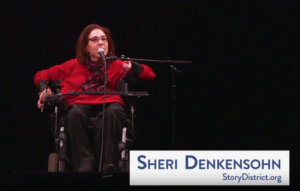 from October to February. It was intense but I loved every minute and I learned to hone this craft. I performed on stage in a theater packed with over 200 people. It was one of the best nights of my life. And then COVID came.
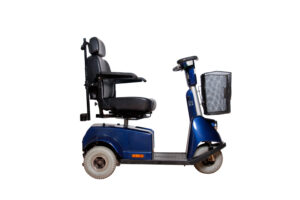 Of course, this got my attention quickly, but there was nothing I could do to reverse the event already in motion. So, in short, I just went off the sidewalk. Fortunately, my head did not come into contact with concrete. If there is anything that Friedreich’s Ataxia improves, it’s your ability to fall without getting hurt; not that you never get hurt when you fall. But I digress! So, I didn’t physically get hurt other than a scrape on one of my elbows, but I needed to get out of the street before any cars came by! As I sat up and told my wife I was OK, a couple of guys came running up to help me. One picked up my scooter and put it back on the sidewalk, and the second put his arms under my arms and lifted me up to a standing position. After the first guy was finished getting my scooter on the sidewalk, he grabbed my ankles and together both guys lifted me back into my scooter.